Saturday, March 26, 2016

Speaking up for public higher education

I'm slowly becoming aware of various groups which are actively speaking up about the budget crisis locally and statewide. This is heartening news. I've already posted links to these groups, but they deserve highlighting.

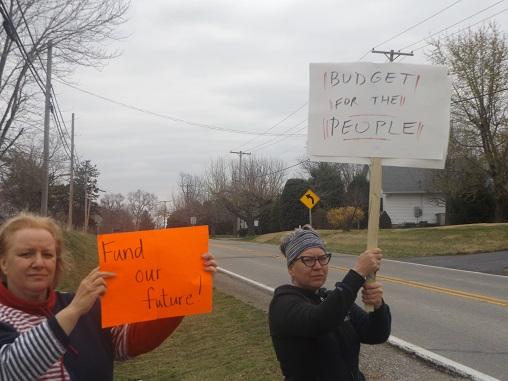
The GA United website has been quite active, as has the SIUC Faculty Association Facebook site. The Speak For Illinois group aims to unite local folks (including JALC and SIUC) to advocate for a state budget, with emphasis on higher education; they held a "Town Hall Meeting" today. I'll give a brief report on it in my next post.

Statewide, the Students, Staff, and Faculty of Illinois Higher Education (also Facebook) need a shorter name, but is quite active, with special emphasis on CSU and EIU.

Finally, the "I Need a Budget Because . . . " Facebook page posts great photos of SIU students giving their own stories. This is really moving stuff.


". . . because first generation college students deserve a chance."

Rauner comes to town

Governor's Rauner's visit to Murphysboro this week was covered in stories from the Southern Illinoisan, the Carbondale Times, and WSIU. The most relevant bit for higher ed from the story in the Southern is this:
In his Q&A session with students, Rauner said the state could use special-purpose funds to pay for higher education now -- if only Democrats in the General Assembly would agree to some savings measures. Democrats and Rauner’s critics have decried the governor’s unwillingness to compromise.
Rauner's budget calls for a 20% cut in state funding (after no funding next year); that's what he means by "funds to pay higher education". The "savings measures" currently advocated by the GOP include "procurement reform", basically a set of changes to streamline the process universities use to purchase things. That may be a good idea--but it is hardly going to save a tremendous deal of money. The "special purpose funds" are funds set aside for, uh, a special purpose. Say, you pay for a hunting license and expect that money to go to the Department of Natural Resources. Instead Rauner suggests we use it to pay for English Composition--and expect state lands in Illinois to take care of themselves. No wonder that an expert cited in the Chicago Tribune (not exactly a progressive source) characterized sweeps as "misleading, at best, and downright deceptive". Re-routing those funds is hardly a case for good government. And sweeping such accounts isn't a steady source of income for anything.
http://mediad.publicbroadcasting.net/p/wsiu/files/styles/medium/public/201603/Protesters.JPG
Some malcontents were not happy to see our Governor.

Friday, March 25, 2016

Squeeze the beast

A brief story from Capitol Fax on the governor's "solution" to the higher education crisis. Rich Miller's link back there via the lovely phrase squeeze the beast gives further help on what passes for a positive agenda for public universities among the state GOP leadership. It's basically the same garbage I tried to refute in this post about the Illinois Policy Institute report excerpted in the DE the other day.

One little point here for my friend Tony Williams, who may be the only one reading this in any event: calls to cut administrative costs may be justified in their own terms but also play into the hands of the GOP. If we cut every unnecessary deanlet, trimmed every bloated administrative salary, and eliminated every unnecessary layer of bureaucracy, the savings would be a pittance compared to the savage cuts the governor is proposing—much less the 100% cut he's imposed this year. So I'm starting to think that our administration's defensiveness on this issue may not only be self-interested (though it certainly is that) but perhaps also smart politics on behalf of public education.

Thursday, March 24, 2016

Dunn hints at financial exigency

The Southern has posted its story on the BOT meeting ending today (Thursday). The headline is the 3% tuition hike. But some language in the Southern article suggests the scariest phrase for any T/TT faculty member: financial exigency. That means layoffs of T/TT faculty. Of course many others on campus are already facing possible layoffs, but Dunn's statement could be the harbinger of even more widespread pain for staff and deeper cuts to our core academic mission. The FA went on strike, after all, to protect tenure and prevent the administration from laying off tenured faculty absent a dire crisis ("financial exigency").

Here's the vital language from the story, especially in the paraphrase of President Dunn. 
“While we haven’t started flipping all of the switches for each one of those listed cuts, … everything’s kind of put in place to move with those,” he said.

In a more dire, “perfect storm” scenario, in which no spending bill is approved for the current fiscal year and no budget is in place for FY17 by mid- to late-June, Dunn said the board may have to consider declaring a fiscal emergency in order to make more significant changes.

IL Supreme Court Rules on Union Cases

Two majors rulings on union cases in Illinois.

In the first, the Supreme Court again ruled that the State Constitution does mean what it says:
Article 13, Section 5. 
 
Membership in any pension or retirement system of the
State, any unit of local government or school district, or
any agency or instrumentality thereof, shall be an
enforceable contractual relationship, the benefits of which
shall not be diminished or impaired.
This time the ruling struck down an effort to cut pensions for public employees of the City of Chicago.

In the second ruling, AFSCME lost a case about back pay. The union agreed to defer some raises that were due back in 2011; the state has never paid up. I frankly don't understand the legal rationale for this decision, but it would seem to cast a certain doubt over moves like the recent one at EIU to defer faculty pay. If such agreements aren't enforceable, they seem a poor option to deal with the current crisis—though none of our options are very good. I would hope IEA lawyers would look into this in the event SIU campus unions are asked to consider pay deferral as an option.